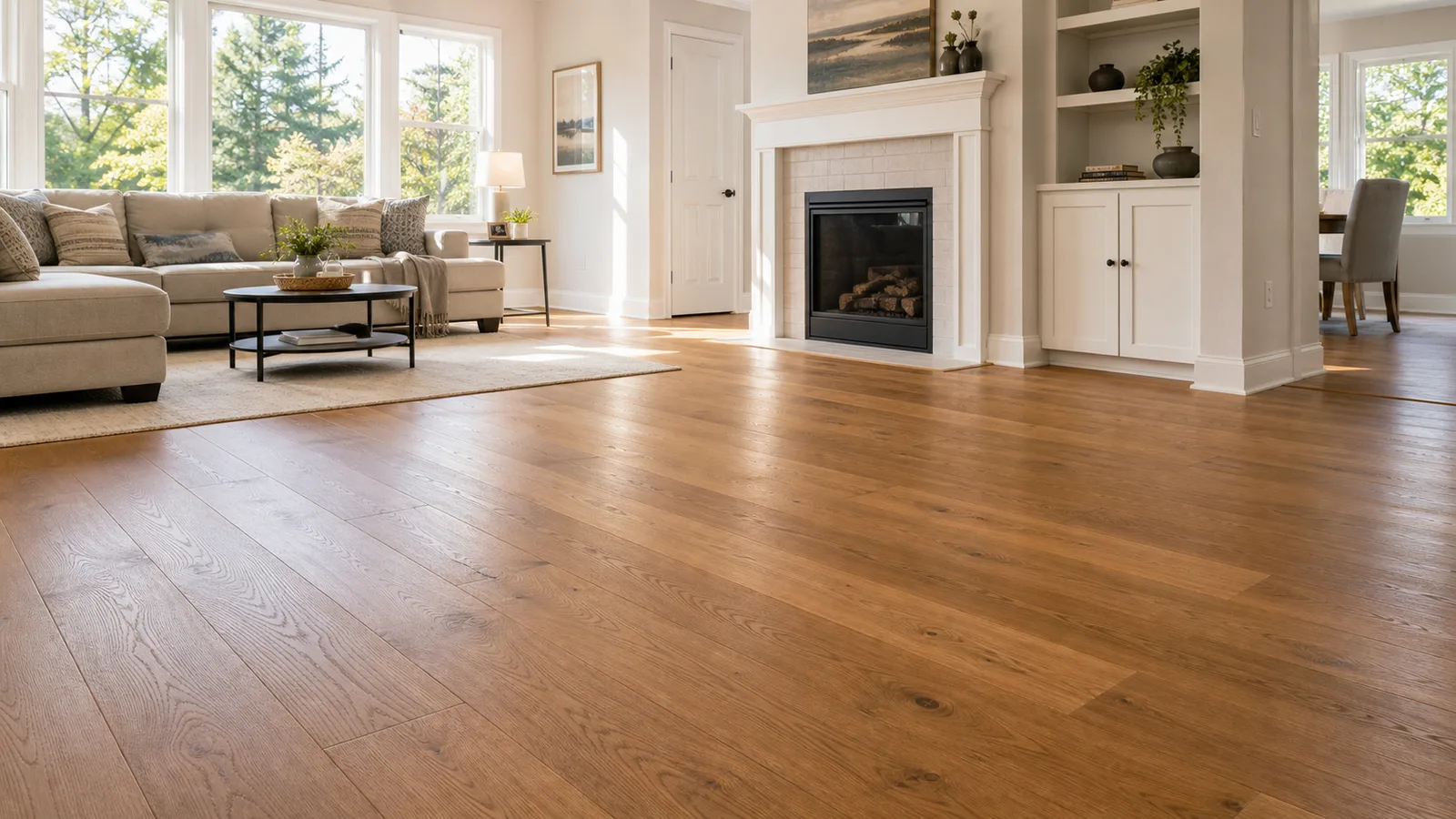
The question isn't which is better, it's which goes where
Walk into any flooring showroom and you'll get pushed toward whatever's on sale. The honest answer is that hardwood and luxury vinyl plank both belong in a Rochester home — just not in the same rooms. The right call depends on the room, the subfloor under it, and how the space gets used through a long Rochester winter when everyone tracks in salt and slush for five months.
---
What each one actually is
Hardwood is real wood — either solid planks or engineered (a real-wood wear layer over plywood). It's warm underfoot, refinishable, and the floor buyers still rank highest. It also moves with humidity and doesn't forgive standing water.
LVP (luxury vinyl plank) is a rigid, fully synthetic plank with a printed wood-look surface and a waterproof core. It's harder to dent, shrugs off moisture, and clicks together over most subfloors. It can't be refinished — when the wear layer is done, you replace it.
---
Cost ranges for 2026
Installed, in a typical Rochester home:
- LVP: $4–$9 per square foot installed. Mid-grade with a thick wear layer lands in the middle.
- Engineered hardwood: $9–$16 per square foot installed.
- Solid hardwood: $10–$18+ per square foot installed, more for wide planks or site-finished work.
For a 300-square-foot room, that's roughly $1,200–$2,700 in LVP versus $3,000–$5,400 in hardwood. Refinishing existing hardwood, if you have it, runs $3–$6 per square foot and often beats replacing it.
---
Where Rochester's climate tips the scale
Two local realities matter more than the showroom lets on.
Humidity swings. Our winters are bone-dry indoors with the furnace running for months, then summer brings humidity back. Wood expands and contracts with that cycle. Solid hardwood needs proper acclimation before installation and a sensible gap strategy, or you get winter gaps between boards and summer cupping. Engineered hardwood handles the swing better. LVP barely notices it.
Salt, slush, and entry points. Mudrooms, entryways, kitchens, and the bottom of basement stairs take a beating from November to April. Standing meltwater and road salt are exactly what hardwood hates and LVP ignores. These are LVP rooms, full stop.
Below-grade and slab. Basements and any room on a slab carry moisture from below. Solid hardwood doesn't belong there. LVP or engineered flooring with the right underlayment does.
---
What older homes add to the decision
Rochester's older housing stock complicates installation more than the flooring choice itself.
- Uneven subfloors. Century-old joists sag and plank subfloors cup. Both flooring types need a flat base, but rigid LVP telegraphs dips and can click apart over a bad subfloor, so leveling work often gets added.
- Original hardwood worth saving. Many Rochester colonials and four-squares have original oak under the carpet. If it's structurally sound, refinishing it is almost always cheaper and adds more value than covering it with anything new.
- Height transitions. Adding LVP over an existing floor raises the height and can foul door swings and thresholds. Worth checking before the boxes arrive.
---
The honest matchups
Resale value: Hardwood wins. In Rochester's market, real wood in the main living areas — living room, dining room, hall, bedrooms — still moves buyers and appraisers in a way vinyl doesn't.
Kids, pets, and high traffic: LVP wins. It takes dog nails, dropped toys, and wet boots without flinching.
Kitchens, baths, basements, entries: LVP wins on moisture alone.
Longevity: Hardwood wins if you'll stay long term — it refinishes two or three times across decades. LVP is replaced, not renewed.
Comfort and feel: Hardwood wins. Quality LVP looks convincing, but underfoot, wood still reads as wood.
---
A layout most Rochester homes are happy with
A common approach that holds up here: hardwood (or refinished original wood) through the main living spaces and bedrooms, and LVP in the kitchen, baths, mudroom, laundry, and basement. You get the resale and warmth of wood where it shows and stays dry, and the durability of vinyl where life is messy and water happens.
---
Mistakes that cost you later
- Putting solid hardwood in a basement or on a slab. Moisture from below will cup or buckle it.
- Skipping subfloor prep on an old house. The flooring is only as flat as what's under it. Leveling is not where to save.
- Buying the thinnest LVP wear layer. A 6-mil wear layer in a busy entry wears through fast. Pay for 12-mil or better where there's traffic.
- Covering salvageable original hardwood. Refinish first, decide later. You can't undo it once it's buried.
---
A practical next step
Walk your house room by room and sort each space into two piles: stays-dry-and-shows (hardwood country) and gets-wet-or-beat-up (LVP country). Check whether there's original hardwood worth saving under existing carpet, and note any floor that feels uneven underfoot.
That room-by-room read is what a good flooring installer needs to give you a real quote — and it usually points to a mix, not a single material for the whole house.