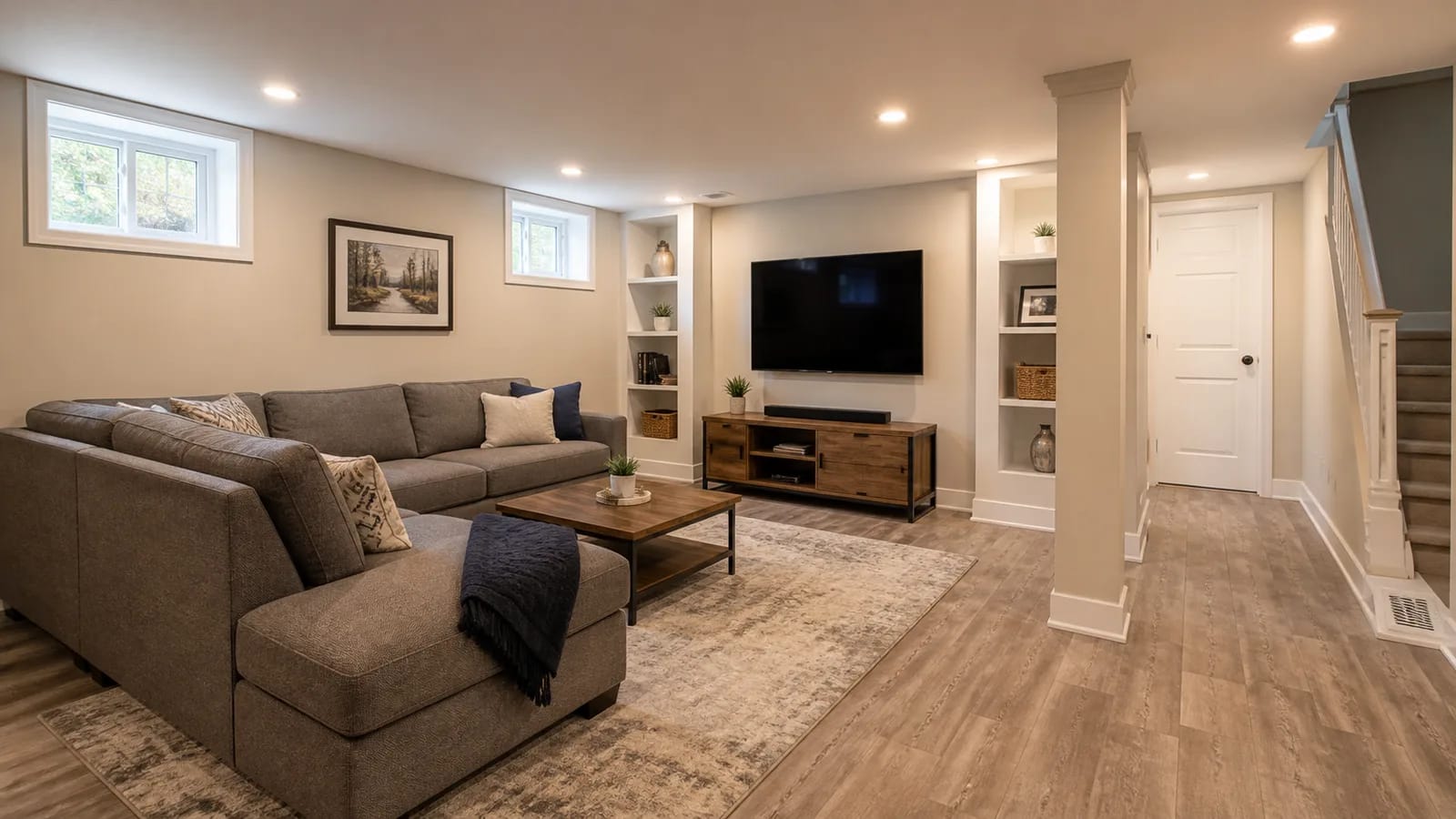
A finished basement is the cheapest square footage you'll ever add
For most Rochester homes, the basement is already there, already heated at the perimeter, and already under roof. Turning it into a family room, a home office, or a guest suite costs far less per square foot than building an addition. That's the appeal. The catch is that no two basements start from the same place, and what's down there before you frame a single wall decides most of the budget.
Before you price finishes, the basement has to be dry and the space has to be code-legal to live in. Skip either and you're not finishing a basement, you're building a problem.
---
Dry comes first, always
A basement that takes on water in spring is not ready to finish, no matter how good the carpet looks in the showroom. Framing and drywall against a wall that weeps after snowmelt traps moisture, grows mold inside the cavity, and forces a tear-out in a few years.
Rochester's clay soil and freeze-thaw cycles make this the single most common reason a basement finish goes wrong. If you've seen water at the floor-wall joint, efflorescence on the block, or a musty smell after heavy rain, deal with drainage and grading before anything else. Our basement finishing work always starts with that conversation, because finishing over an unsolved water problem is the most expensive mistake on this list.
---
Real cost tiers for 2026
These are working ranges for a typical 600 to 900 square foot Rochester basement, assuming the space is already dry:
- Basic finish: $25,000–$40,000. Framing, insulation, drywall, drop or drywall ceiling, LVP flooring, recessed lighting, paint, and a simple egress-compliant layout. One open room.
- Mid-range with a bathroom: $45,000–$70,000. Everything above plus a half or full bath, which means running drain lines, often a sewage ejector pump if the basement sits below the sewer line, and the plumbing and electrical permits that go with it.
- High-end suite: $75,000–$120,000+. Multiple rooms, a full bath, a wet bar or kitchenette, upgraded finishes, built-ins, and egress windows cut into the foundation.
Square footage matters less than what systems you add. A bathroom and an egress window will move the number more than another 200 square feet of open floor.
---
What older Rochester basements hide
This is where surprises live, and Rochester's housing stock is old enough that surprises are common.
Low headroom. Many pre-1960 homes have basement ceilings under seven feet once you account for ductwork and beams. New York's code generally wants 7 feet of finished ceiling height in habitable basement space. A maze of low ducts and pipes can force rerouting or a creative ceiling plan, and sometimes it caps what the space can legally become.
Ductwork, beams, and the main stack running right where you wanted a clean ceiling. Boxing them out is normal, but it eats headroom and adds framing labor.
Knob-and-tube or an undersized panel. A finished basement adds circuits — lighting, outlets, maybe a bathroom and HVAC. If the existing service can't carry the load, a panel upgrade gets added to the job.
No egress. A basement bedroom legally requires an egress window or door — an opening large enough to climb out of in a fire. Cutting one into a poured or block foundation and building the window well runs $4,000–$8,000 on its own. There's no skipping it if the room will be called a bedroom.
---
The permit and egress rules you can't design around
Finishing a basement into livable space almost always requires a permit in Rochester and the surrounding Monroe County towns, and it triggers inspections for framing, electrical, insulation, and egress. This is not red tape to route around. An unpermitted finished basement is one of the first things a buyer's agent or appraiser flags at sale, and a basement bedroom with no legal egress can't be advertised as a bedroom at all.
The rules that catch people:
- A room marketed as a bedroom needs a conforming egress window or exterior door.
- A bathroom needs proper venting and, if below the sewer line, an ejector pump.
- Insulation and vapor control have to meet code for our climate zone, which affects how walls get built against the foundation.
A contractor who pulls the permit and builds to inspection is protecting your resale value, not padding the bill.
---
Where the money is well spent
- Moisture control and proper wall assembly. Rigid foam or a framed wall with the right vapor strategy against the foundation keeps the space dry and comfortable. This is not the place to cut.
- Egress, done right. If there's any chance the room becomes a bedroom, build the egress now. Retrofitting later costs more and disrupts a finished space.
- Lighting and ceiling height. Basements fight a low, dim feeling. Recessed lighting and the highest ceiling the structure allows are what make the space feel like part of the house instead of a converted cellar.
---
Where it's tempting to overspend
- A second full kitchen you don't need. A kitchenette is cheaper and rarely costs you anything at resale.
- Premium flooring on a slab. LVP handles the occasional bit of basement humidity better than hardwood and costs less. Save the hardwood for upstairs.
- Finishing every square foot. Leaving a dedicated mechanical and storage zone unfinished is smart, not lazy. It keeps the furnace, water heater, and panel accessible.
---
A practical next step
Walk your basement after the next heavy rain or spring melt and look honestly: any water at the joints, any musty smell, how much real headroom you have under the ductwork. Measure the ceiling height in the lowest spot. Decide whether you actually need a bedroom (egress) and a bathroom (plumbing), because those two choices set the budget more than anything else.
Bring that read to an estimate. A contractor who asks about water, headroom, and how you'll use the space before quoting a price is the one giving you a real number.