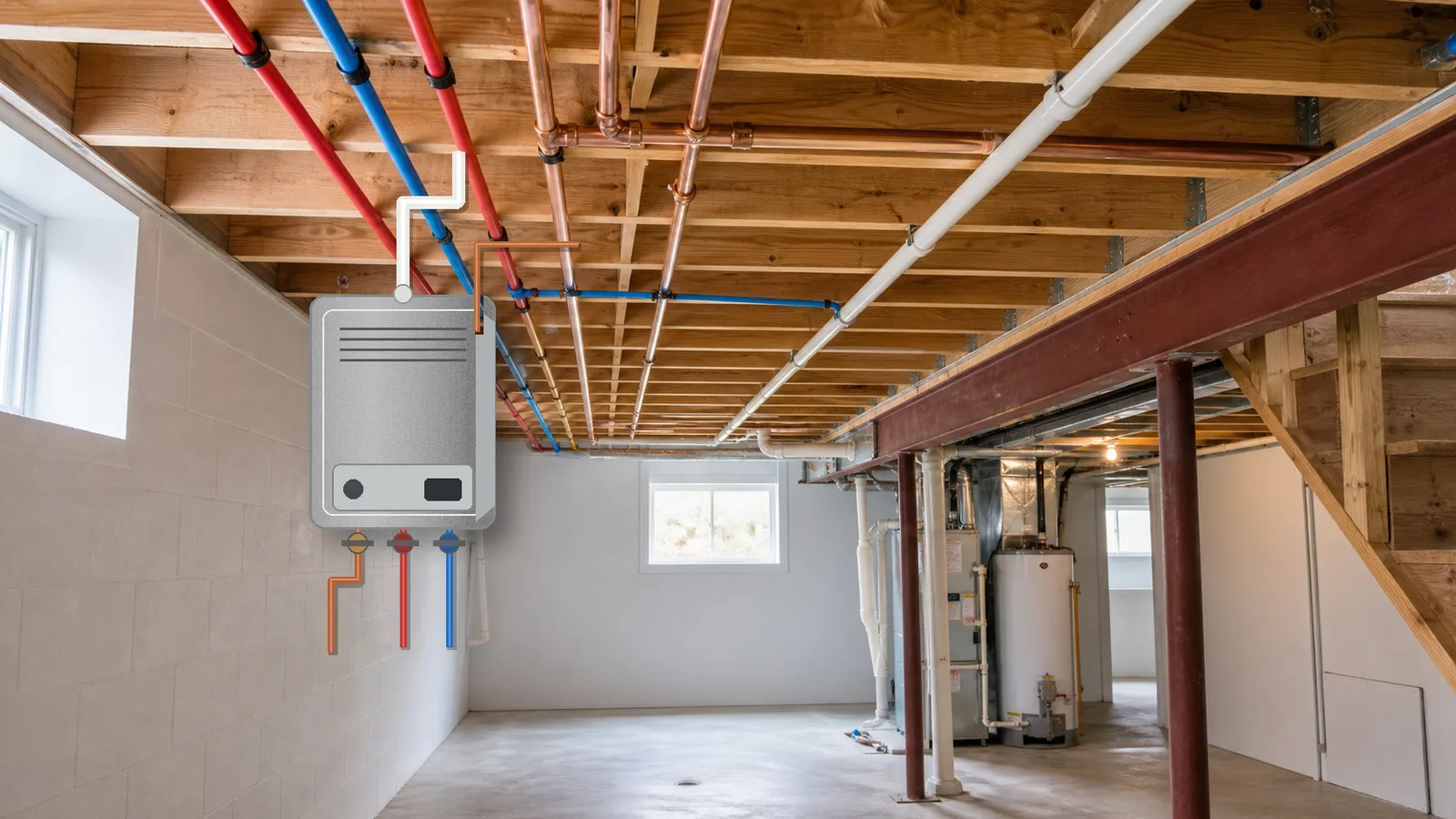
When the old tank starts leaking, you have a decision
Water heaters last about 8–12 years, and they almost always fail at the worst time, usually as a puddle around the tank in the basement. When yours goes, you'll be choosing fast between another tank and going tankless. Worth understanding the tradeoff before you're standing in a wet basement deciding under pressure.
---
How each one works
Tank (storage): keeps 40–50+ gallons hot and ready around the clock. Simple, cheap to install, proven. The downside is standby loss (it reheats water you're not using) and a finite tank — run it dry with back-to-back showers and you wait.
Tankless (on-demand): heats water only as it flows, so you don't pay to keep a tank warm and you don't run out. The catch is capacity: it can only heat so much water per minute, and that limit depends on how cold the incoming water is.
---
The Rochester catch: cold incoming water
This is the part generic guides miss. A tankless heater's output is rated by how much it can raise the water's temperature at a given flow. In winter, Rochester's incoming groundwater is cold, sometimes near 40°F. To deliver a 105°F shower, the unit has to work much harder than it would in a warm climate. That means you need a properly sized (and often larger) tankless unit to run two showers at once in January. An undersized tankless feels great in summer and disappoints in winter. Sizing for our coldest water is the whole game.
---
What it costs in 2026
- Tank replacement (gas or electric): $1,500–$3,000 installed.
- Tankless (gas): $3,500–$6,500+ installed — the unit costs more and often needs new gas line sizing and venting.
- Tankless (electric): can require a significant electrical upgrade for whole-house use; often impractical in older homes without panel work.
Tankless costs more up front, mostly in installation: venting, gas line upsizing, and sometimes electrical.
---
The honest tradeoffs
Endless hot water: tankless wins. Big households that run out with a tank notice this most.
Up-front cost: tank wins, clearly.
Operating cost: tankless saves on standby loss, but the payback on the higher install stretches over many years. Don't expect it to pay for itself fast.
Lifespan: tankless lasts longer (15–20 years vs 8–12), which helps the long-term math.
Space: tankless wins — it's wall-mounted and frees up basement floor.
Hard water: Rochester water is moderately hard; tankless units need periodic descaling to protect the heat exchanger. Skip the maintenance and you shorten its life.
---
When each makes sense here
Go tankless if: you run out of hot water with your current tank, you'll stay in the home long term, you want the space back, and you'll keep up with descaling.
Stick with a tank if: up-front cost matters most, your hot-water demand is modest, or going tankless would force expensive gas or electrical upgrades.
---
Mistakes to avoid
- Undersizing a tankless for our cold winter water — the #1 regret here.
- Ignoring descaling in Rochester's hard water and killing the unit early.
- Assuming fast payback. Tankless is about endless hot water and longevity, not a quick energy refund.
- Replacing in a panic without comparing — get the comparison before the old one floods.
---
A practical next step
Note your household's hot-water pain: do you actually run out, or is the tank fine and just old? Check your fuel (gas vs electric) and whether the heater sits where venting a tankless would be straightforward.
A licensed plumber can size a tankless for Rochester's winter water and tell you honestly whether it's worth the premium over a quality tank for your home and usage.