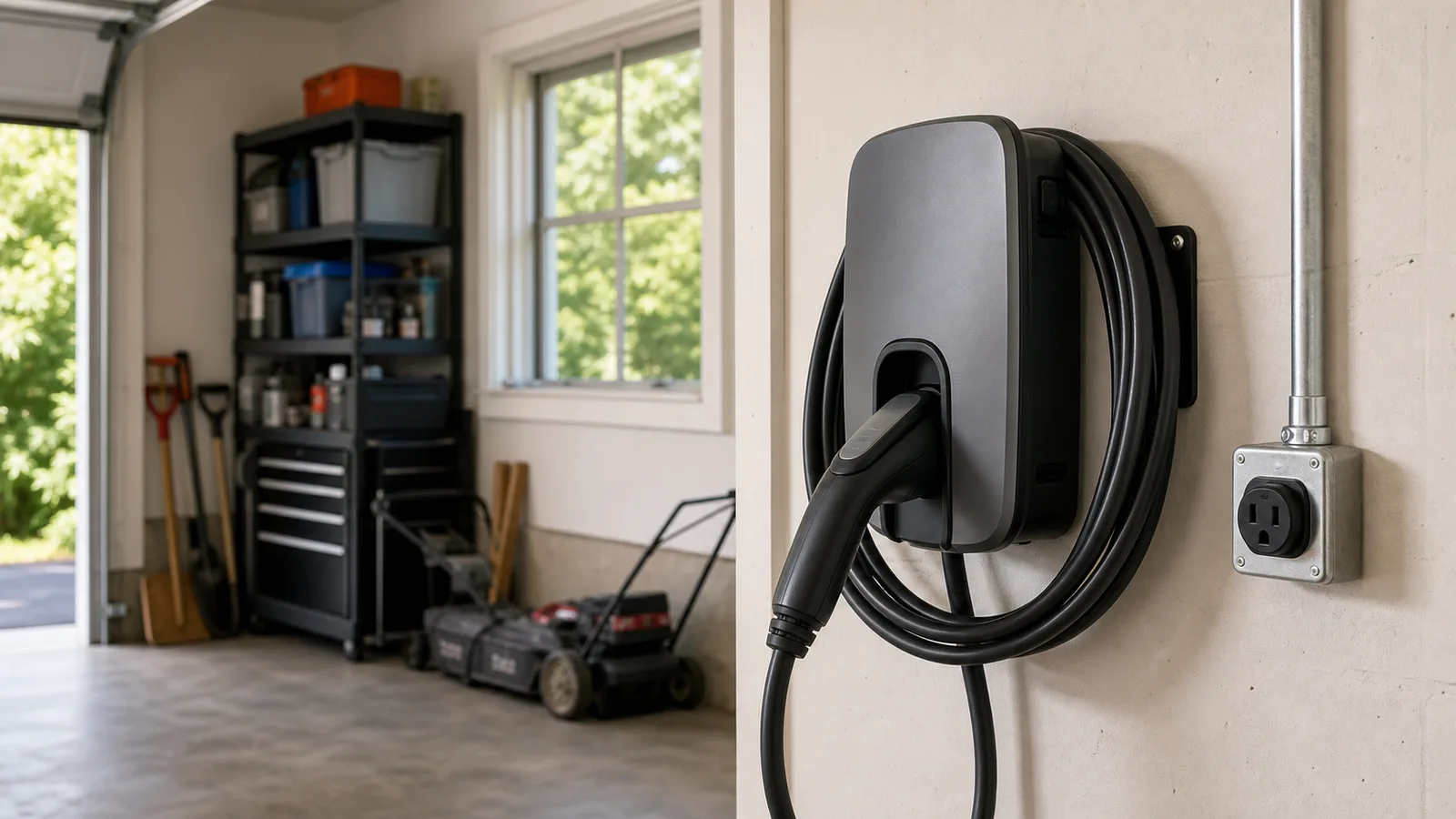
Charging at home is the whole point
The best part of owning an electric car through a Rochester winter is never standing at a public charger in the cold. You plug in at home, leave warm and full every morning. But getting a proper home charger means a bit more than buying a unit and hanging it on the garage wall, especially in our older housing stock.
---
Level 1 vs Level 2
Level 1 is the cord that comes with the car, plugged into a standard outlet. It adds only a few miles of range per hour, which barely keeps up with daily driving and crawls in cold weather. Fine as a backup, not as your main plan.
Level 2 runs on a 240-volt circuit, the same kind a dryer or range uses, and adds roughly 20–40 miles of range per hour. It charges most cars overnight. This is what almost everyone wants installed, and it's where the electrical work comes in.
---
What the install actually involves
A Level 2 charger needs a dedicated 240V circuit run from your electrical panel to where the car parks, usually the garage or driveway side of the house. The job is:
- Confirming your panel has the capacity and a free slot for a new high-amperage circuit.
- Running the circuit (distance from panel to parking spot drives cost).
- Mounting the charger or installing a 240V outlet (NEMA 14-50) the charger plugs into.
- Permit and inspection.
---
What it costs in 2026
- Simple install (panel near the garage, short run, capacity available): $700–$1,500.
- Typical install (moderate wire run, outlet or hardwired charger): $1,500–$3,000.
- With a panel upgrade (older home, no capacity): add $2,500–$5,000 for the panel work.
The charger unit itself runs $400–$800 on top, unless it came with the car.
---
The older-home catch: your panel
This is where Rochester homes add cost. An EV charger is a big continuous load. Many older homes have 100A service that's already busy with AC and appliances, with no room for a 40–50A charger circuit. In that case the panel or service has to be upgraded first. It's not optional — overloading an undersized panel is a fire risk and won't pass inspection.
If a heat pump is also in your future, plan the panel for both at once rather than upgrading twice.
---
Don't skip the permit
EV charger installation requires a permit and inspection in Rochester and Monroe County towns. A licensed electrician pulls it. This protects you on insurance and at resale, and confirms the high-amperage circuit was done safely. Anyone offering to skip it to save time is the wrong hire.
---
Mistakes to avoid
- Buying the charger before checking your panel. Capacity comes first; the unit is the easy part.
- Relying on Level 1 and wondering why you never wake up to a full battery in January.
- Cheaping out on the circuit. An undersized or improperly run circuit is a hazard on a load this size.
- Unpermitted work, which can void insurance and complicate a sale.
---
A practical next step
Look at where your car parks relative to the electrical panel, and check your panel's amperage and whether it has open breaker slots. If it's 100A and already full, factor a panel upgrade into the plan.
A licensed electrician can confirm your panel's capacity, size the circuit, and give you one number that covers the charger, the wiring, and any panel work your home actually needs.